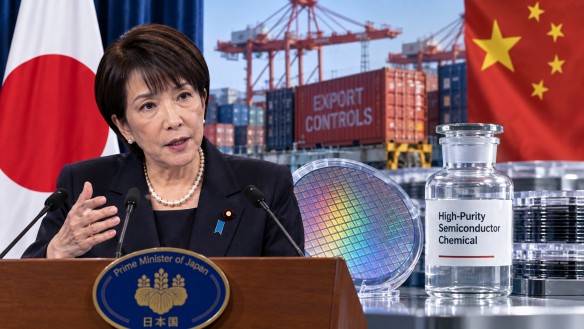
Japan has expressed strong disapproval of China’s newly imposed export restrictions on dichlorosilane (DCS), a critical chemical in semiconductor manufacturing, highlighting concerns about the potential repercussions for Japanese businesses. The new measures require Chinese importers of Japanese DCS to submit cash deposits of up to 99.2%, directly impacting Japanese exporters like Shin-Etsu Chemical and Denal Silane.
China has justified these restrictions as provisional, claiming that an anti-dumping investigation revealed detrimental effects from Japanese DCS exports on its domestic industry. This investigation is ongoing, with a final decision anticipated upon its conclusion. In response, the Japanese government has called on China to ensure that these measures do not disproportionately harm Japanese companies, signaling its readiness to take necessary action to protect its interests.
The development occurs against a backdrop of deteriorating relations between China and Japan, exacerbated by Japan’s stance on Taiwan. This tension has been reflected in Beijing’s broader strategy of imposing trade and export restrictions on Japanese firms, particularly those dealing with dual-use products that could have military implications.
Dichlorosilane plays a vital role in the semiconductor industry by facilitating the creation of extremely thin silicon layers on computer chips. Given Japan’s position as a leading global supplier of ultrapure DCS, these restrictions pose a significant challenge to the semiconductor supply chain.