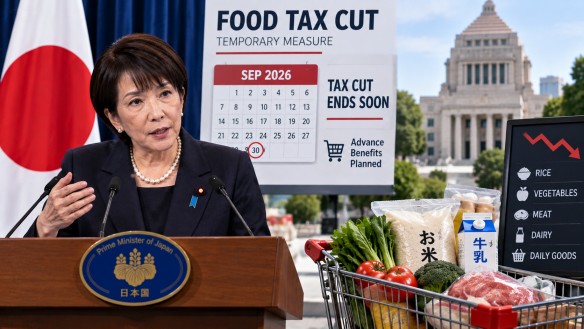
Japan’s government is set to implement a new strategy to support low- and middle-income households as the country prepares for the end of a temporary reduction in the consumption tax on food in 2029. Under this forthcoming policy, starting in April 2027, the consumption tax on food will be significantly lowered from 8% to 1% for a two-year period. To cushion the impact when the tax reverts to its original rate in April 2029, eligible households will receive half of their annual benefits in advance.
The income-based support initiative is scheduled to launch in 2027, aligning payments with household income and the number of children. The financial support distributed under this program is projected to amount to approximately ¥600 billion, or $4 billion, annually for the fiscal years of 2027 and 2028. The government is working towards finalizing the policy details by September, with plans to introduce the necessary legislation during a special parliamentary session anticipated in October.
To finance this temporary tax reduction, Japan’s government intends to re-evaluate existing subsidies, special tax measures, and its own expenditure, steering clear of issuing deficit-financing bonds. However, the precise sources of funding are still under consideration and have not yet been finalized.
Beyond direct household benefits, the government also intends to implement measures to aid sectors that could be impacted by the tax adjustment, particularly agriculture, forestry, fisheries, and restaurant businesses. Retailers, too, will be given additional time to adapt to the tax-inclusive pricing display requirements that accompany these changes.