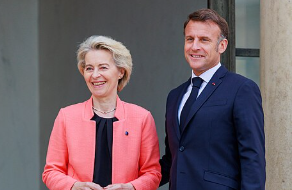
European leaders reached agreement on advancing “Buy European” policies to protect strategic industries during their summit addressing Europe’s competitive decline. The gathering of all 27 member states at Alden Biesen castle in Belgium focused on developing coordinated responses to challenges from global competitors and unfair trade practices.
French President Emmanuel Macron and German opposition leader Friedrich Merz arrived together at the summit, demonstrating unity on the urgency of European action despite policy differences. Macron has long championed European preference, arguing that strategic sectors including clean technologies, chemicals, steel, automotive, and defense require protection “otherwise Europeans will be swept aside.” He describes “Buy European” as “a defensive measure” made essential because “we are facing unfair competitors who no longer respect the rules of the World Trade Organization.” This framing positions European preference not as protectionism but as legitimate defense against competitors who have abandoned rules-based trade.
Merz, however, advocates for “Made with Europe” rules that would favor trading partners rather than narrowly focusing on “Made in Europe” standards. This reflects Germany’s traditional emphasis on open markets and its extensive supply chains that extend beyond European borders. German manufacturers rely heavily on components from around the world, and narrowly defined European content requirements could disrupt these supply chains and increase costs. Merz also champions aggressive deregulation and new trade deals as complementary strategies to boost European competitiveness, reflecting ordoliberal German economic thinking that emphasizes rules-based competition rather than industrial policy.
Irish Prime Minister Micheál Martin expressed caution about European preference, stating: “We must protect the open free trade ethos of the European Union in my view.” Ireland’s economy depends heavily on foreign direct investment, particularly from American technology and pharmaceutical companies that use Ireland as their European headquarters. Irish leaders worry that European protectionism could trigger American retaliation that would harm Ireland’s role as a bridge between American investment and European markets. Ireland also benefits from rules-based trade that prevents larger European countries from favoring their national champions over Irish companies.
The summit revealed emerging coalitions that may reshape European economic policymaking. Italy, Germany, and Belgium co-hosted a pre-summit gathering of 19 member states to discuss “initiatives needed to ‘relaunch Europe’s industry.'” Topics included review of the emissions trading system, the EU’s carbon pricing mechanism that some manufacturers blame for competitive disadvantages against rivals in countries without carbon prices. This Italian-German partnership raises questions about the traditional Franco-German relationship that has historically driven European integration. While Macron and Merz demonstrated cordiality, they disagree fundamentally on European preference scope and on the EU’s trade deal with Mercosur countries in South America, which Merz supports but Macron dismisses as “a bad deal.”