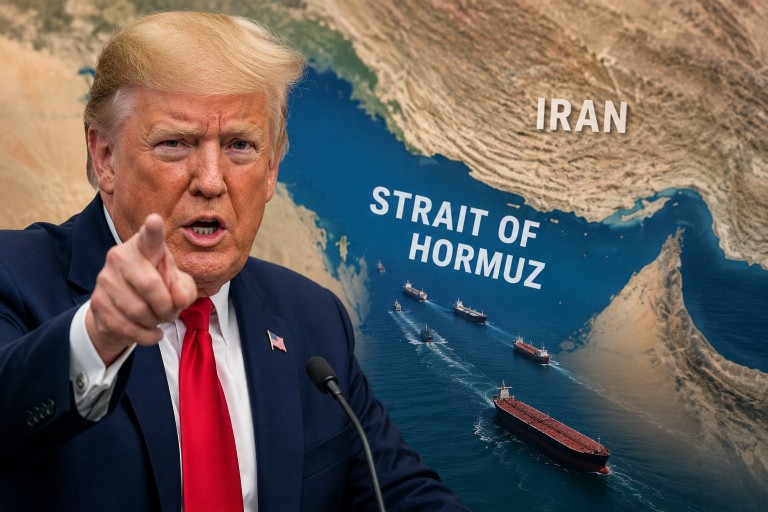
In a significant development, U.S. President Donald Trump has indicated the possibility of declaring the Strait of Hormuz as “a territory of the United States,” amid ongoing tensions with Iran. Speaking in New York on Friday, Trump suggested that this declaration would follow the U.S.’s victory over Iran, claiming that the U.S. already exercises control over the strategic waterway through a blockade. The Strait of Hormuz holds critical importance as a maritime passage, with approximately 20% of the world’s seaborne oil supply traversing it. The waterway, situated between Iran and Oman, has been largely restricted since the onset of military actions by the U.S. and Israel against Iran.
The implications of Trump’s remarks are yet to be clarified, leaving it uncertain whether they signal a shift in U.S. policy or serve as a political statement. The comments have garnered a strong reaction from Iran, with Deputy Foreign Minister Kazem Gharibabadi dismissing the threat, emphasizing that Tehran would not succumb to U.S. pressure. He reiterated that decisions regarding the strait’s operational status lie firmly under Iran’s jurisdiction. Meanwhile, Iranian Foreign Minister Abbas Araqchi stated that Tehran has not committed to resuming negotiations with Washington, noting that the current exchanges through intermediaries like Qatar and Pakistan do not amount to formal talks.
Iran has outlined specific conditions before consenting to the reopening of the strait for shipping activities. These include demands for war damage compensation, lifting of sanctions, and the release of frozen Iranian assets. The ongoing conflict and resulting disruptions in shipping have driven fuel prices upward, impacting consumers worldwide. President Trump defended the increased prices, arguing that the additional costs are necessary to prevent Iran from acquiring a nuclear weapon.
The persistent standoff over the Strait of Hormuz has raised global concerns regarding energy supplies and the broader economic ramifications of the conflict. As the situation continues to unfold, the international community remains watchful of any developments or resolutions that may arise from this tense geopolitical landscape.